


ADA Parking Lot Striping Services: Virginia Guide 2026

Updated: Sep 16
ADA parking lot striping services ensure that commercial properties, retail centers, and municipal lots throughout Virginia meet federal accessibility standards while keeping traffic flow safe and organized. These services combine precise line marking, proper signage placement, and code-compliant handicap spaces so every visitor, regardless of mobility, can access a building safely. For property managers and business owners, getting this right is not optional; it is a legal requirement under the Americans with Disabilities Act. In addition, well-maintained striping protects a property from liability and keeps daily operations running smoothly.
What Are ADA Parking Lot Striping Services?
ADA parking lot striping services are professional pavement marking solutions that create accessible parking spaces, access aisles, and directional signage in compliance with the Americans with Disabilities Act. Specifically, a qualified contractor measures space dimensions, applies durable traffic paint, and verifies compliance with both federal and Virginia accessibility codes.
In practice, this means combining engineering knowledge with hands-on line-marking skill. For example, technicians must know the exact width required for van-accessible spaces versus standard accessible spaces, along with the correct blue paint hue and international symbol of accessibility placement. Similarly, they must position signage at the height required by the U.S. Access Board guidelines so it remains visible to drivers approaching from any direction.
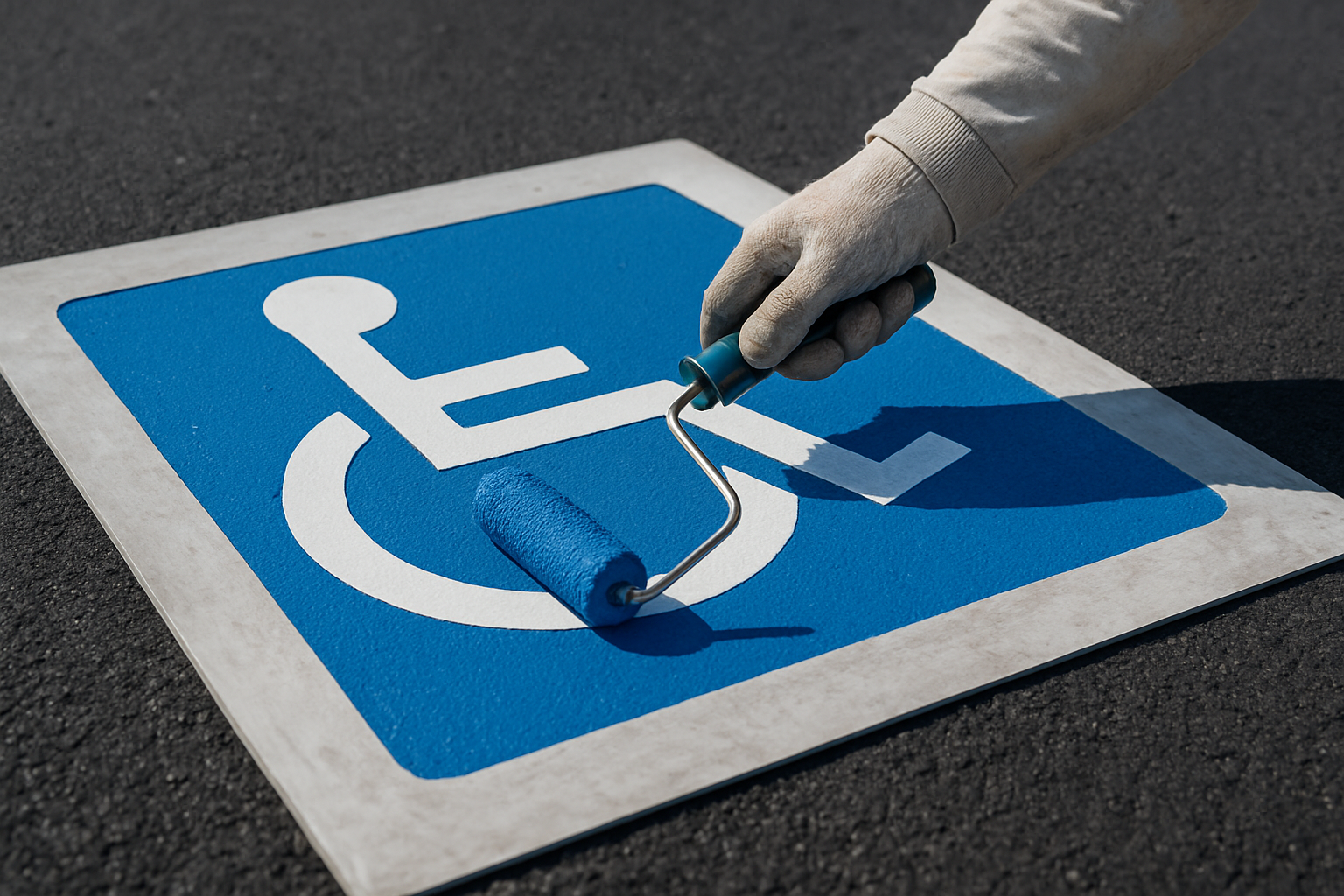
ADA parking lot striping services require precise stencil work to keep the accessibility symbol crisp and code-compliant.
Why ADA Compliance Matters for Virginia Properties
ADA compliance matters because federal law requires places of public accommodation to provide accessible parking. As a result, property owners who ignore these requirements risk complaints, lawsuits, and costly retrofits. According to the U.S. Department of Justice's ADA.gov, parking access violations remain among the most commonly cited accessibility issues nationwide.
Consequently, keeping striping current is one of the simplest ways to reduce legal exposure. Furthermore, accessible parking benefits everyone. Clear markings reduce confusion, improve traffic flow, and create a welcoming impression for customers, tenants, and visitors. In particular, retail centers and homeowners associations benefit from professional line striping services because sharp, well-maintained lines signal attention to detail and community care.
Key ADA Parking Lot Requirements You Must Meet
Virginia parking lots must follow the ADA 2010 Standards for Accessible Design, which set specific requirements for space counts, dimensions, and signage. Above all, the required number of accessible spaces scales with total parking capacity. For instance, a lot with 25 total spaces needs at least one accessible space, while larger lots require additional van-accessible spots.
Key requirements typically include:
At least one van-accessible space for every six accessible spaces
A minimum 96-inch-wide accessible space with an adjacent 60-inch access aisle
Van-accessible aisles of at least 96 inches wide
Signage mounted at the height specified by Access Board guidelines
Slip-resistant blue paint meeting state reflectivity standards
A properly laid out lot shows accessible spaces, access aisles, and standard rows working together seamlessly.
The Process for ADA-Compliant Line Striping
Understanding the full sequence helps property managers set realistic expectations and timelines. Therefore, here is how most Virginia contractors approach the job, including the full striping process from start to finish.
Site Assessment and Measurement: A qualified team measures the total parking capacity, reviews existing markings, and calculates exactly how many accessible and van-accessible spaces the Virginia code requires for that lot size.
Layout Planning and Marking: Technicians use chalk lines or laser-guided layout tools to mark accurate space widths, access aisles, and signage locations before any paint touches the pavement.
Surface Preparation: Crews clean, sweep, and sometimes seal coat the pavement surface so new striping adheres properly and lasts through Virginia's seasonal temperature swings.
Application of ADA-Compliant Markings: Using durable traffic-grade paint, crews apply the international symbol of accessibility, space lines, and van-accessible lettering according to exact code specifications.
Final Inspection and Sign-Off: The completed work is inspected against ADA checklists to confirm space counts, dimensions, and signage placement meet both federal and Virginia accessibility standards.
What Affects the Cost of Accessible Parking Lot Marking?
Cost depends on lot size, the number of required accessible spaces, paint quality, and whether seal coating is needed first. In particular, industry estimates suggest standard line striping generally runs $0.15 to $0.35 per linear foot, while ADA-compliant symbols and signage add roughly $150 to $400 per accessible space depending on complexity.
In contrast, larger municipal or retail properties often qualify for volume pricing across multiple lots. Similarly, bundling striping with professional parking lot painters for a full repaint typically costs less per space than scheduling separate visits. For a deeper cost breakdown by lot size, the complete Virginia striping guide offers additional pricing context.
Accurate measurement before painting keeps costs predictable and prevents rework.
Common Mistakes in ADA Parking Lot Marking
Even well-intentioned property owners make errors that create compliance risk. Common mistakes include undersized access aisles, missing van-accessible spaces, incorrect signage height, and allowing faded lines to go unrepainted for too long. As a result, a lot that was compliant when built can drift out of compliance simply through wear.
Furthermore, some contractors use standard traffic paint instead of the specific reflective blue required for accessible symbols, which can lead to inspection failures. Therefore, working with a crew experienced specifically in ADA requirements, rather than general striping alone, reduces the chance of costly rework later.
Choosing a Reliable ADA Striping Contractor in Virginia
Selecting the right contractor matters as much as the paint itself. Above all, look for a company that understands both Virginia's climate demands and federal accessibility codes. Master Markings, for example, specializes in parking lot striping, ADA-compliant handicap markings, and seal coating for commercial properties, HOAs, retail centers, and municipalities across Virginia. For a deeper walkthrough, see our Asphalt Seal Coating.
In addition, a dependable provider should offer clear timelines, transparent pricing, and minimal disruption to daily operations. Property managers can review examples of past work, such as how Master Markings can restore any commercial parking lot, before committing to a project. To request a quote or learn more about available services, visit mastermarkings.com directly.
Frequently Asked Questions About ADA Parking Lot Striping Services
What are ADA parking lot striping services?
ADA parking lot striping services are professional pavement marking projects that create accessible parking spaces, access aisles, and signage that meet the Americans with Disabilities Act standards. They include measuring, layout planning, and applying compliant paint and symbols.
How many ADA-compliant parking spaces does a Virginia parking lot need?
The required number scales with total lot size under the ADA 2010 Standards. For example, a lot with 26 to 50 total spaces needs at least two accessible spaces, with the ratio increasing for larger lots.
Why is ADA parking lot striping important for property owners?
It is legally required for places of public accommodation and reduces the risk of complaints or lawsuits. In addition, clear accessible markings improve safety and create a more welcoming property for all visitors.
How wide must an ADA-compliant handicap parking space be?
A standard accessible space must be at least 96 inches wide with an adjacent 60-inch access aisle. Van-accessible spaces require a wider 96-inch access aisle to accommodate lift-equipped vehicles.
What is the difference between van-accessible and standard accessible spaces?
Van-accessible spaces include a wider access aisle and additional vertical clearance for vehicles with side or rear lifts. Standard accessible spaces have narrower aisles and are intended for cars without lift equipment.
How much do ADA parking lot striping services cost?
Costs vary based on lot size and space count, but ADA-compliant symbols and signage typically add $150 to $400 per accessible space beyond standard line striping rates. Larger municipal or retail lots often receive volume pricing.
How long does ADA parking lot striping take to complete?
Most commercial lots are completed within one to two days, depending on size and paint cure time. Larger properties or those requiring seal coating first may take longer.
What paint colors are required for ADA parking lot markings?
Accessible space symbols and borders must use a specific reflective blue, while access aisles are typically marked with blue or white hatching. Local codes in Virginia may specify exact shade and reflectivity standards.
What are common mistakes in ADA parking lot marking?
Common mistakes include undersized access aisles, missing van-accessible spaces, incorrect signage height, and allowing faded lines to go unrepainted. These errors can trigger compliance complaints even when the intent was accessible design.
How often should ADA parking lot markings be repainted?
Most Virginia properties repaint striping every 12 to 18 months due to weather exposure and traffic wear. Faded accessible symbols should be refreshed immediately since visibility is part of ADA compliance.
Can property owners be fined for non-compliant ADA striping?
Yes, non-compliant properties can face formal complaints, civil penalties, and required corrective retrofits. Municipalities and businesses are equally responsible for maintaining compliant accessible parking.
Do HOAs and municipalities need ADA parking lot striping too?
Yes, HOAs, retail centers, and municipal lots open to the public must provide ADA-compliant accessible parking. Requirements apply regardless of whether the property is privately owned or government operated.
Final Thoughts
Ultimately, ADA parking lot striping services protect property owners from legal risk while making parking areas safer and more welcoming for everyone. From measuring space requirements to applying durable, code-compliant paint, each step matters for long-term compliance. Therefore, Virginia property managers, HOAs, and business owners should prioritize working with an experienced contractor who understands both federal ADA standards and local pavement conditions. Above all, investing in professional, well-maintained ADA parking lot striping services now helps avoid costly retrofits and keeps a property inspection-ready year after year.

