


Asphalt Driveway Contractors: How to Choose the Best One

Updated: Sep 16
Asphalt driveway contractors are the specialists homeowners and property managers call on when a smooth, durable, code-compliant driveway surface is the goal — especially in a state like Virginia, where humid summers and freezing winters put real stress on pavement. Finding the right crew, however, is rarely simple, because pricing, materials, and workmanship vary dramatically from one paving company to the next. This guide goes further than a typical overview: it breaks down exactly what asphalt driveway contractors do, how to vet them step by step, what fair pricing looks like across Virginia, and how to keep a new driveway performing well for fifteen years or longer.
Quick Answer: Asphalt driveway contractors are licensed paving professionals who grade, install, and maintain asphalt driveways — including base preparation, hot-mix paving, compaction, seal coating, and crack repair. The most reliable ones carry proper insurance, provide detailed written estimates, and back their work with a written warranty. In contrast, companies that skip these basics tend to produce driveways that fail within a few short years.
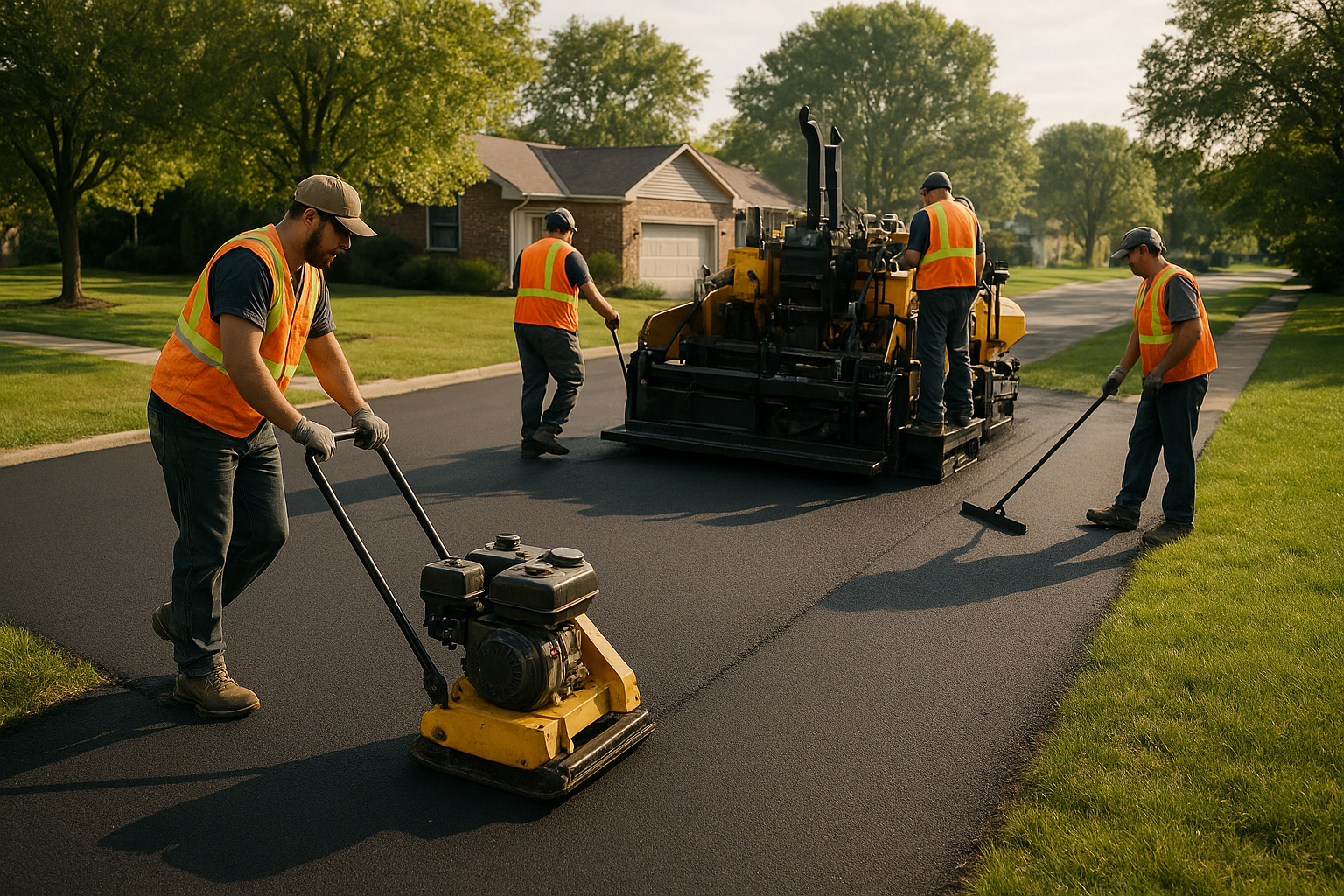
Experienced asphalt driveway contractors combine proper base prep with careful compaction for a lasting surface. For a deeper walkthrough of how to compare paving companies side by side, see our News and Insights.
What Are Asphalt Driveway Contractors?
Asphalt driveway contractors are paving specialists who handle the full lifecycle of an asphalt surface, from grading raw ground to sealing the finished pavement. Their scope typically includes excavation, stone base installation, hot-mix asphalt paving, compaction, and edge finishing. Many companies, including regional pavement maintenance firms, also handle follow-up services such as seal coating, crack sealing, and line striping for commercial lots.
Asphalt concrete, commonly called blacktop, is a mixture of aggregate and bitumen binder that is compacted while hot and cures as it cools. Because it flexes slightly with temperature swings, it tends to resist cracking better than rigid materials in climates with freeze-thaw cycles, according to the Wikipedia entry on asphalt concrete. That flexibility is exactly why proper installation technique matters so much — a flexible material still needs a rigid, well-compacted base underneath it to perform as intended.
Why Hiring Professional Paving Contractors Matters
A driveway that looks fine on installation day can fail within a year or two if the base was not compacted correctly. Consequently, skipping proper base preparation is one of the most common reasons pavement fails early. The Federal Highway Administration notes that base stability and drainage design are among the leading factors in pavement longevity, whether the project is a highway or a home driveway.
In addition, professional crews understand how to grade a driveway so water sheds away from the foundation instead of pooling near the garage. Standing water is one of the fastest ways to accelerate asphalt breakdown, especially through repeated freeze-thaw cycles common across Virginia winters. Above all, correct grading is nearly impossible to fix after the fact without tearing out the surface, so this step deserves close attention before any asphalt is poured.
How to Choose the Right Asphalt Driveway Company
Vetting a contractor does not need to be complicated, but it does require a consistent process. The following steps help narrow the field to companies that will still stand behind their work years later.
Verify licensing and insurance. Ask for proof of business licensing and general liability insurance before any equipment arrives on site.
Request local references and photos. Look at driveways completed two or more years earlier to see how the asphalt has actually held up.
Compare written estimates line by line. Collect at least three quotes and compare base depth, asphalt thickness, and drainage plans, not just the final number.
Confirm materials and installation process. Ask what base material will be used and how thick the finished asphalt layer will be. For a deeper walkthrough, see our News and Insights.
Review warranty and communication practices. Get workmanship guarantees in writing and note how responsive the company is throughout the estimate process.
How to Get Accurate Quotes From Asphalt Paving Companies
Getting a fair, comparable quote is often where homeowners get tripped up, since no two estimates are formatted the same way. Follow this process to make apples-to-apples comparisons across multiple asphalt driveway contractors.
Measure your driveway's square footage first. Walk the space and record length and width so every contractor is pricing the exact same project area, which prevents confusing quote comparisons later.
Invite at least three contractors for an on-site visit. Phone estimates miss drainage issues, soil conditions, and access obstacles that only become clear when someone walks the property in person.
Require written specifications for base depth and asphalt thickness. A trustworthy estimate spells out exact measurements in inches rather than vague phrases like "standard base" or "quality asphalt."
Line up each quote side by side. Compare material specifications, drainage plans, warranty length, and total price together, rather than ranking bids by price alone.
Confirm the project timeline and payment schedule in writing. Reputable asphalt driveway contractors rarely demand full payment upfront and will outline start dates, weather contingencies, and curing time clearly.
What Services Do Local Paving Professionals Offer?
Beyond new driveway installation, most full-service paving professionals also handle resurfacing, patching, seal coating, and crack sealing. Commercial-focused companies, such as Master Markings, extend that list further with parking lot striping, ADA-compliant handicap markings, curb painting, and traffic line marking for retail centers, HOAs, and municipalities across Virginia.
For homeowners specifically, understanding the installation process from start to finish makes it easier to spot shortcuts. This guide to building an asphalt driveway breaks down each stage in more detail, from excavation through final compaction. Meanwhile, if your existing surface already shows surface damage, our crack repair services can often extend driveway life well past the point many homeowners assume replacement is the only option.
Seal coating protects newly paved driveways from sun, water, and oil damage between resurfacing projects.
How Much Do Asphalt Driveway Contractors Charge in Virginia?
Pricing depends on square footage, base condition, and asphalt thickness. As a general benchmark, industry sources such as the Asphalt Institute point to a typical national range of $3 to $7 per square foot for new residential asphalt paving, though local labor and material costs shift that range slightly.
Therefore, a quote that comes in far below others is worth a closer look, since it often means thinner asphalt, a skipped base layer, or no compaction step at all. Specifically, ask any unusually low bidder to put their base depth and asphalt thickness in writing before signing anything.
Asphalt vs. Concrete vs. Gravel: Which Driveway Material Wins?
Homeowners often research asphalt driveway contractors without first confirming that asphalt is actually the right material. The comparison below outlines where each option performs best.
In particular, asphalt tends to win for Virginia homeowners because it flexes with temperature swings instead of cracking outright, and it can be reopened for use within a day or two of paving, unlike concrete, which needs a longer curing period before vehicles can drive on it.
Common Mistakes to Avoid When Hiring Paving Crews
Even careful homeowners run into avoidable problems when hiring in a hurry. In particular, watch for these recurring issues:
Accepting the lowest bid without comparing base depth and asphalt thickness.
Skipping the request for proof of insurance and licensing.
Failing to get warranty terms in writing before work begins.
Ignoring drainage slope, which leads to standing water and premature cracking.
Red Flags That Signal an Unreliable Asphalt Contractor
Beyond the common mistakes above, certain behaviors during the sales process are strong predictors of poor workmanship later. Specifically, be cautious of contractors who:
Pressure same-day signing with "leftover material from another job" discounts.
Refuse to provide a physical business address or local references.
Offer only verbal estimates with no written scope of work.
Demand full payment before any work begins on site.
Cannot explain their base preparation or compaction process clearly.
As a result, any one of these red flags alone should prompt a second opinion; several together are usually a clear sign to keep looking.
Maintaining Your Driveway After Installation
Once a driveway is installed, ongoing maintenance determines how many years it lasts. Seal coating every two to three years shields the surface from UV exposure and oil stains, while prompt crack sealing keeps water from seeping into the base layer. For a deeper look at budget-friendly upkeep, this article on seal coating asphalt on a budget covers practical timing and cost-saving strategies.
Similarly, small cracks left unaddressed tend to widen quickly during freeze-thaw cycles. The guide on crack filling for a refreshed driveway explains how this low-cost step can noticeably extend pavement life. For broader upkeep habits, caring for your asphalt driveway and repairing asphalt driveways both offer additional seasonal maintenance tips worth reviewing.
Line striping and ongoing seal coating work together to keep paved surfaces safe and code-compliant.
Asphalt Driveway Lifespan: What Actually Affects How Long It Lasts
A well-installed and properly maintained asphalt driveway typically lasts 15 to 20 years, but several factors move that number up or down. For instance, climate, drainage, traffic weight, and maintenance frequency all play a measurable role, according to pavement research published by the National Asphalt Pavement Association.
Base depth: A thicker, well-compacted stone base resists rutting under heavy vehicles.
Drainage slope: Proper grading prevents water from pooling and seeping under the surface.
Sealing frequency: Seal coating every two to three years slows oxidation and surface wear.
Vehicle weight: Driveways built for cars may degrade faster under heavy trucks or RVs.
Climate exposure: Repeated freeze-thaw cycles, common in Virginia, stress pavement more than stable climates.
Why Virginia Property Owners Choose Master Markings
For commercial properties, HOAs, and municipalities, pavement upkeep extends well beyond a single driveway. Master Markings specializes in parking lot striping, ADA-compliant handicap markings, curb painting, crack sealing, and asphalt seal coating for commercial properties throughout Virginia, including suburban HOAs, retail centers, and municipal lots across Northern Virginia, the Richmond area, and Hampton Roads. Above all, the company focuses on precision and durability tailored to the region's climate, helping property managers stay compliant while minimizing disruption to daily operations. Visitors can review current services directly at mastermarkings.com before requesting a project estimate.
Frequently Asked Questions
What do asphalt driveway contractors do?
Asphalt driveway contractors grade the ground, install a compacted stone base, pave hot-mix asphalt, and compact the surface so it drains properly and holds up under vehicle weight. Many also offer seal coating, crack sealing, and line striping as follow-up maintenance services.
How much does it cost to hire asphalt driveway contractors?
Most homeowners pay between $3 and $7 per square foot for a new asphalt driveway, depending on thickness, base preparation, and regional labor rates. A typical two-car driveway often falls in the $2,500 to $7,000 range.
How long does a new asphalt driveway take to install?
A standard residential driveway usually takes one to three days to pave, though full curing can take up to a year. Larger commercial lots take longer depending on square footage and drainage work.
What is the difference between asphalt and concrete driveways?
Asphalt driveways cost less upfront, install faster, and flex slightly with temperature changes, while concrete lasts longer but cracks more visibly and costs more to install. Climate and budget usually decide which material makes more sense.
How often should a driveway be seal coated?
Most asphalt driveways benefit from seal coating every two to three years. Seal coating protects the surface from UV rays, water intrusion, and oil stains, which extends the pavement's usable life.
Can asphalt driveway contractors repair cracks instead of replacing the driveway?
Yes, in most cases. Crack sealing and patching can add several years to a driveway's life if the base underneath is still stable, which is far less expensive than a full replacement.
What questions should I ask before hiring a paving company?
Ask about licensing, insurance, base depth, asphalt thickness, warranty length, and whether the crew is direct employees or subcontractors. Also request photos of recent, comparable projects.
Why does asphalt driveway pricing vary between contractors?
Pricing varies because of differences in base preparation, asphalt thickness, material quality, and overhead costs. A low bid often signals thinner asphalt or skipped base work, which fails sooner.
What time of year is best for asphalt paving in Virginia?
Late spring through early fall offers the ideal temperature range for asphalt paving in Virginia, generally between 50°F and 85°F. Paving in extreme heat or cold can weaken compaction and shorten pavement life.
How can I tell if a contractor's work will last?
Look for consistent slope for drainage, clean edges, uniform color, and a written warranty covering workmanship. Checking references from projects completed two or more years ago is one of the best indicators.
Do asphalt driveway contractors offer warranties?
Reputable contractors typically offer a one to five year workmanship warranty covering cracking, settling, or drainage issues caused by installation errors. Always get warranty terms in writing before work begins.
What is the average lifespan of an asphalt driveway?
A well-installed and properly maintained asphalt driveway typically lasts 15 to 20 years. Regular seal coating and prompt crack repair are the biggest factors in reaching the higher end of that range. For a deeper walkthrough, see our News and Insights.
Are permits required for driveway paving projects?
Permit requirements depend on the local jurisdiction and whether the driveway connects to a public road. Established asphalt driveway contractors typically know local code requirements and can confirm if a permit applies to your project.
Can asphalt driveway contractors pave over an existing concrete driveway?
Sometimes, but only when the concrete slab is structurally sound and properly cracked and drained first. Otherwise, underlying concrete problems will reflect through the new asphalt layer within a year or two.
Do asphalt driveway contractors offer financing options?
Many larger paving companies offer payment plans or third-party financing for bigger projects. It's worth asking directly during the estimate, since financing terms and interest rates vary widely between contractors.
What is the ideal asphalt thickness for a residential driveway?
Most residential driveways perform well with two to three inches of compacted asphalt over a properly prepared stone base. Thinner layers may look fine initially but tend to rut and crack sooner under regular vehicle traffic.
Final Thoughts
Ultimately, choosing among asphalt driveway contractors comes down to verifying credentials, comparing detailed estimates, and confirming that base preparation and warranty terms are handled properly. A driveway installed correctly the first time, and maintained with routine seal coating and crack sealing, can easily last 15 to 20 years without major repairs. Property owners in Virginia who take the time to vet asphalt driveway contractors thoroughly, rather than choosing the lowest bid, consistently end up with safer, longer-lasting pavement and fewer surprises down the road.

